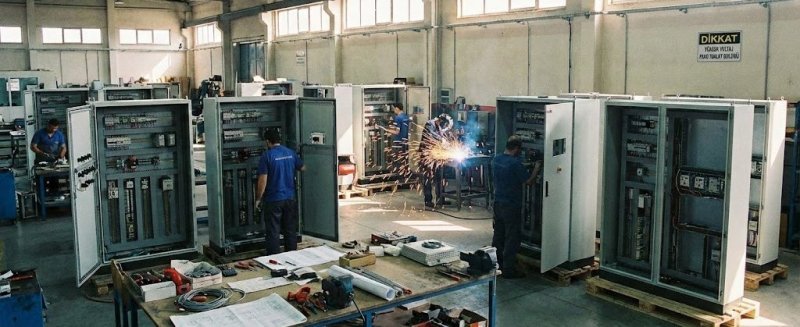
The manufacturing process begins with detailed electrical drawings, load calculations and component specifications. Engineers determine cable sizing, breaker types, busbar capacities, earthing requirements and IP protection ratings. CAD-based simulations verify thermal performance, short-circuit withstand capacity and internal wiring layout to minimize power losses.
Panels typically include circuit breakers, contactors, relays, overload protection devices, PLC modules, meters, busbars and cable ducts. Enclosures are produced from powder-coated steel, galvanized sheet, aluminum or composite materials. Copper or aluminum busbars are insulated with heat-resistant coatings to maintain conductivity under high current loads.
During assembly, mechanical structures are mounted, busbars are aligned, DIN rails are installed and devices are positioned according to design standards. Skilled technicians perform internal wiring using labeled cables, ferrules and crimped connectors to ensure traceability and serviceability. Wiring routes are optimized for heat management and electrical isolation.
Panels undergo insulation resistance tests, high-voltage dielectric tests, continuity checks, torque measurements and thermal scanning. Quality control teams verify compliance with IEC, UL or ISO standards. Certified panels receive labeling for serial tracking, fault current rating and environmental protection class.
Electrical panels are essential in manufacturing plants, data centers, energy facilities, machinery automation lines, water treatment plants and building management systems. They integrate communication modules, remote monitoring and SCADA-compatible interfaces for smart industrial control.