High-tensile galvanized steel forms the backbone of most bolted tower systems because it delivers optimal rigidity-to-weight ratios. Micro-alloyed formulations improve elasticity during sudden load transfer, especially on angles where line direction changes. Structural members follow standardized profiles that balance bending resistance and torsional strength. Testing data from recent industry evaluations indicates that properly fabricated bolted joints retain more than 90% of their designed clamping force even after prolonged thermal cycling, which illustrates the reliability of engineered metal-to-metal interfaces.
Wind pressure, frost accumulation, solar heat, and soil conditions shape the overall strength calculation for each tower design. Engineers use regional meteorological records spanning at least 30 years to determine extreme event scenarios, ensuring the tower geometry and bolt spacing patterns match real-world conditions. In high-altitude or coastal networks, additional bracing may be integrated to mitigate oscillations. Empirical measurements from operational corridors show that damping features can reduce conductor-induced vibration amplitudes by up to 40%.
Bolted transmission line towers improve grid reliability by providing modular, serviceable, and dimensionally stable structures that maintain conductor alignment under fluctuating mechanical and climatic conditions. Their predictable failure modes, high interchangeability, and fast field assembly contribute directly to network uptime, preventive maintenance planning, and long-term asset efficiency.
The reliability advantage stems from their distributed load pathways, which allow structural members to share stress across multiple joints. When tension spikes—such as during short-circuit events—load dispersion prevents localized deformation. Utilities consistently report fewer emergency interventions for bolted towers compared to welded field-assembled structures, largely because damaged sections can be replaced rapidly without cutting or re-welding precision components.
Bolted towers support modern digital inspection techniques. Smart sensors placed at critical joints measure torque retention, vibration signatures, and micro-movement patterns. Algorithms interpret these signals to forecast potential fatigue points before they affect service continuity. Studies from international grid operators show that early detection programs can reduce unplanned shutdowns by approximately 25%.
Remote terrain projects benefit significantly from bolted systems because transportation logistics require lightweight, pre-drilled segments. Helicopter-assisted delivery operations achieve higher success rates when tower components follow standardized lengths and hole geometries. Assembling a medium-voltage double-circuit tower often takes less than half the time required for equivalent welded structures, enabling utilities to meet tight expansion schedules.
Bolted joints maintain consistent clamping through controlled friction surfaces. This stability moderates the oscillatory forces transmitted from conductors to the tower body. Wind tunnel experiments conducted on lattice tower prototypes revealed that strategically placed diagonal bracing combined with reinforced bolted nodes can reduce lateral drift by up to 17% under storm-level wind speeds.
Bolted transmission line towers follow strict engineering rules that balance mechanical performance, manufacturability, and field interchangeability. These rules encompass geometry, steel grade, bolt class, coating systems, and hole spacing.
A lattice configuration minimizes total material consumption without compromising strength. Triangulation distributes loads through multiple pathways, ensuring that failure of a single member does not trigger full structural collapse. The geometry also reduces wind shadow effects by allowing air to pass through the tower body, lowering aerodynamic forces.
High-strength friction-grip bolts create joints that resist slip even under severe line tension. Engineers select bolt grades based on shear capacity, tensile strength, and expected torque retention. Typical assemblies use standardized hole diameters that accommodate controlled expansion during thermal cycles. Laboratory fatigue tests consistently demonstrate the durability of double-nut locking configurations.
Galvanization remains the most widely used protection method because of its proven resistance to atmospheric corrosion. Zinc coatings applied by hot-dip processes create metallurgical bonding that can last several decades in moderate climates. In industrial regions with high sulfur exposure, duplex systems combining galvanization and powder coating provide extended service life.
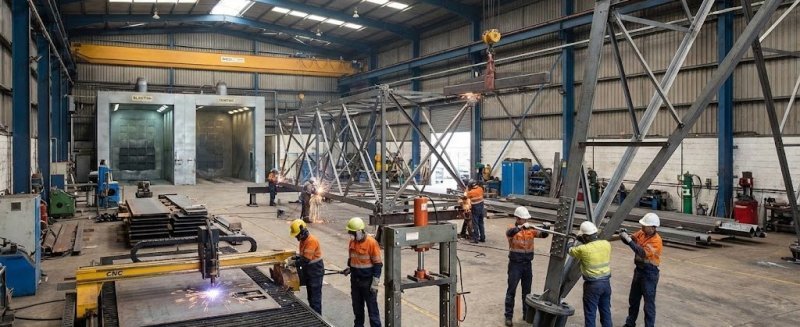
Efficient production involves precise material cutting, automated drilling, bolt preparation, and final quality assurance. Each step contributes to the structural reliability that field crews depend on.
Computer-controlled cutting machines ensure accurate member lengths and minimize material waste. The angle profiles are formed to maintain consistent load distribution across the tower’s height. Dimensional accuracy often falls within a tolerance of a few millimeters, ensuring seamless alignment during assembly.
Drilling lines create bolt holes that match digital design files. Maintaining perpendicularity and consistent spacing prevents misalignment that could weaken joint performance. Automated systems record data from every drilled hole, forming a traceable quality log for long-term documentation.
Before shipment, manufacturers conduct trial assemblies of selected tower sections. These checks verify that the bolt holes align perfectly and that member fitment meets engineering plans. According to industrial audits, trial fitting reduces field installation time by nearly 30%.