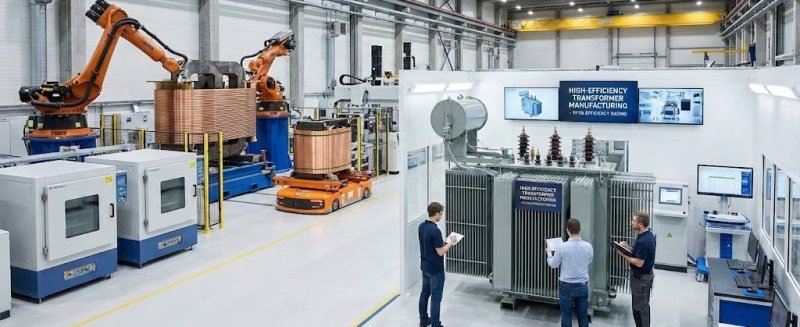
A high-performance transformer is defined by stable magnetic flux behavior, low losses, optimized thermal flow and durable insulation capable of withstanding mechanical and electrical stresses without degradation. These requirements become measurable through no-load loss metrics, short-circuit withstand capabilities, partial discharge thresholds and temperature rise limits. Rolling-grade silicon steel, oxygen-free copper conductors, epoxy-bonded insulation systems and precision-cut laminations all contribute to this performance framework.
Grain-oriented silicon steel with low hysteresis has proven capable of loss reductions of up to 30% in large distribution units. Precision stacking with staggered joints improves flux uniformity, while stress-relief annealing restores magnetic properties after cutting. These principles directly influence long-term efficiency and compliance with modern energy standards.
A transformer is manufactured through a sequence of engineered stages that ensure magnetic integrity, mechanical stability and electrical safety at each point. The following steps reflect industry-standard practices supported by measurable process parameters.
Suppliers provide laminations, copper or aluminum conductors and specialized resins with certification data verifying chemical composition, mechanical strength and dielectric behavior. Conductors are inspected for conductivity values within 97–101% IACS range depending on alloy specifications. Core laminations undergo dimensional checks with tolerances often kept within ±0.02 mm to maintain stacking accuracy.
Laminations are cut according to the geometry dictated by the design. Automated cutting machines with CNC alignment ensure consistent burr-free edges. Core stacking follows standardized pressure profiles to minimize air gaps; a reduction of 0.05 mm in cumulative air gap can lower no-load losses by approximately 2–4%. Bolted or clamped structures are tightened at controlled torque values to prevent mechanical hum and maintain magnetic continuity.
Winding machines place conductors with tension-controlled mechanisms to prevent hotspots caused by uneven compaction. Paper-insulated, enamel-coated or continuously transposed conductors are selected according to voltage class and desired thermal rating. Multi-layer windings employ radial spacers to facilitate oil or air circulation. A controlled winding tension—typically between 15–35 N for medium-size coils—maintains geometric consistency and reduces short-circuit deformation risk.
Wound coils are dried in vacuum ovens where moisture content is reduced below 0.5%. Vacuum pressures commonly reach 0.1–1 mbar. This drying stage is crucial because even a 1% increase in moisture can decrease dielectric strength by nearly 10%. Mechanical reinforcement elements such as pressboard cylinders, spacers and clamping structures are installed to enhance short-circuit resilience.
The coil is carefully lowered onto the core or vice-versa depending on the configuration. Alignment determines both magnetic symmetry and noise characteristics. Clamping structures are tightened using calibrated hydraulic systems. Internal clearances are verified to maintain dielectric distances aligned with standards such as IEC 60076.
Coils undergo vacuum pressure impregnation (VPI) or oil-filling processes depending on transformer type. • VPI processes ensure resin penetration into all micro-gaps, improving mechanical rigidity. • Oil-filled units rely on degassed mineral or synthetic insulating oil with moisture levels below 10 ppm.
The tank is welded using continuous seams tested by X-ray or ultrasonic inspection. Radiators or cooling fins are mounted to enhance heat dissipation. Surface protection systems include zinc-rich primers and UV-resistant top coats. A durable coating system can extend outdoor lifespan by over 15 years.
Every transformer undergoes a full suite of tests:
| Test Type | Purpose |
|---|---|
| No-load and load loss measurement | Determines efficiency and core quality |
| Induced and applied voltage tests | Confirms dielectric strength |
| Temperature rise test | Verifies thermal stability |
| Partial discharge assessment | Detects insulation imperfections |
| Short-circuit withstand test | Proves mechanical durability |
This structured testing approach ensures compliance with international performance benchmarks.
High-grade materials determine transformer reliability, efficiency and service life. Each selection is based on empirical testing, thermal modeling and dielectric behavior verified through long-term field data.
Grain-oriented silicon steel is used in over 90% of distribution transformers due to its low core loss profile. Amorphous metal cores reduce losses by up to 70% compared to conventional laminations, making them suitable for high-efficiency applications.
Copper remains preferred for high-capacity units because of its superior conductivity and mechanical resilience. Aluminum conductors provide weight and cost advantages, particularly in distribution-level transformers.
Pressboard, polymer composites, epoxy resins and high-temperature papers form the layered insulation network. Their dielectric strength typically ranges between 8–20 kV/mm depending on density and moisture levels.
Mineral oil, synthetic ester and natural ester fluids are used to manage heat transfer. Synthetic esters offer fire-safe operation with flash points above 300°C, making them suitable for indoor installations.
Transformer design directly affects magnetic, thermal and electrical behavior. The most energy losses occur through core hysteresis, eddy currents and resistive heating in windings. Advanced designs incorporate:
Finite element modeling (FEM) highlights flux distribution and enables engineers to adjust limb width, yoke height and air-gap minimization strategies. Reducing core flux density from 1.7 T to 1.6 T can decrease noise amplitude by up to 8 dB and reduce core losses significantly.
Interleaved or disc-type winding arrangements control leakage reactance and optimize voltage regulation. Short-circuit forces can exceed several thousand newtons; therefore, winding geometry must be robust enough to maintain shape under stress.
Cooling ducts, oil channels and radiator sizing ensure stable operating temperatures. A properly engineered cooling path can reduce winding temperature by 5–10°C, increasing insulation lifespan by nearly 20%.
Testing ensures that transformers perform reliably in long-term operational scenarios. Power networks demand uninterrupted performance; thus, each unit undergoes diagnostic checks that simulate real-world stress.
PD levels below 5 pC are typical for high-quality units. Excessive PD indicates insulation voids that can lead to dielectric failure.
A 40–55°C temperature rise limit is common for many classes. Thermal sensors and infrared imaging verify even heat distribution across the core and windings.
Magnetostriction effects in the core create audible sound. Precision clamping and optimized lamination stacking help maintain noise levels within regulatory guidelines.
Modern transformer production uses digital modeling, automated machinery and sensor-embedded components to improve performance.
